Sectors
Defibrillators for
offices and corporate sites.
Predictable hours, reception-led access and multiple floors make offices straightforward to cover well, and easy to get quietly wrong.
40,000+
out-of-hospital cardiac arrests happen in the UK every year (British Heart Foundation), and workplaces are where adults spend their days
Fewer than 1 in 10
people survive one (British Heart Foundation). Early defibrillation is what shifts the odds
3 to 5 min
defibrillation within this window gives the best chance (European Resuscitation Council). Stairs, lifts and long corridors eat into it fast
What we do
Defibrillator cover designed for *office buildings*
Reception visibility, realistic walking routes between floors, and monitoring that fits normal business hours. That is the shape of good office cover.
Reception-first siting
Visible from the main entrance and signed from lift lobbies and stairwells.
Floor-by-floor cover
Walking-time checks decide whether upper floors need a second device.
Monitored every day
An automatic daily self-check, not just when the office manager remembers.
Briefings for wardens
We help you develop briefings so wardens know the location and the first steps.
How we approach it
Risk, placement and *readiness*
What drives the risk in an office building, where a device genuinely needs to live across multiple floors, and how it stays ready without relying on one busy office manager. Here is how we answer the three questions that matter.
01
The risk profile
Office cardiac arrests are more common than most teams expect, simply because that is where working adults spend their days. Risk rises with headcount, an older workforce, and visitor traffic. Multiple floors are the hidden factor: a device by reception can be several minutes away from the top floor when lifts are busy, and in a cardiac arrest every minute of delay reduces the chance of survival.
02
Where devices should live
We start from reception or the main circulation route, where a device is visible, signed and reachable by anyone including visitors. For multi-floor buildings we map realistic walking routes rather than assuming the lift, and where the top floors fall outside a comfortable round trip we recommend a second unit rather than relying on optimism. Cabinets stay unlocked internally so nobody is hunting for a code.
03
Keeping them ready
Offices usually have a facilities lead or office manager who inherits the defibrillator along with everything else. Monitored devices remove the burden: the device self-checks every day and reports to us, and pads are replaced before they expire. We help you develop short staff briefings so the location and the basic steps stay familiar, with reception and floor wardens the natural people to know exactly where the device lives.

In practice
What *good office cover* looks like
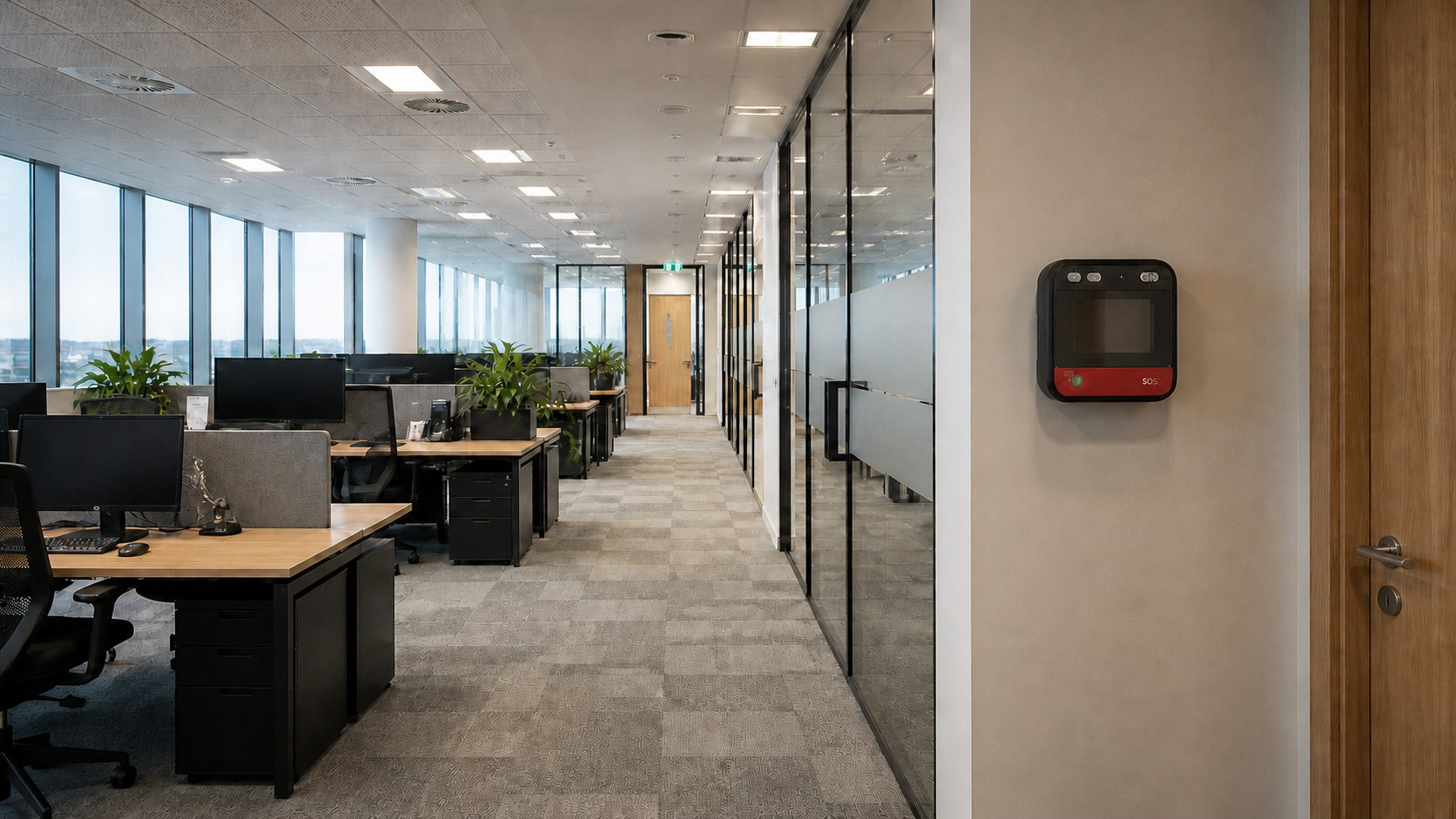
A monitored device by reception, signed from the lift lobby and reachable from every floor within the window that matters. Visible to staff and visitors alike, self-checked every day, and never waiting on a key. That is what good office cover looks like day to day: nobody thinks about the defibrillator until the moment it matters, and in that moment nobody has to. Our free assessment shows you how close your building is to that standard.
See how ready your workplace is
Answer a few questions about your site and get an instant, indicative readiness result with clear next steps.
Try our assessment tool