FAQs
Straight answers to common questions
If yours is not covered here, ask us directly. We would rather explain than assume.
The basics
What Work Defib *actually is*
The service in plain terms: what you get, how it behaves and who it suits.
What is Work Defib?
Work Defib supplies, sets up and monitors workplace defibrillators for UK organisations. You get the Primedic HeartSave myPAD and a choice of three options: buy it outright, Complete Protection (professional set-up plus monitoring and support), or rent it with everything included. See our pricing for details. Work Defib is a trading name of Home Defib Ltd.
What does monitored actually mean?
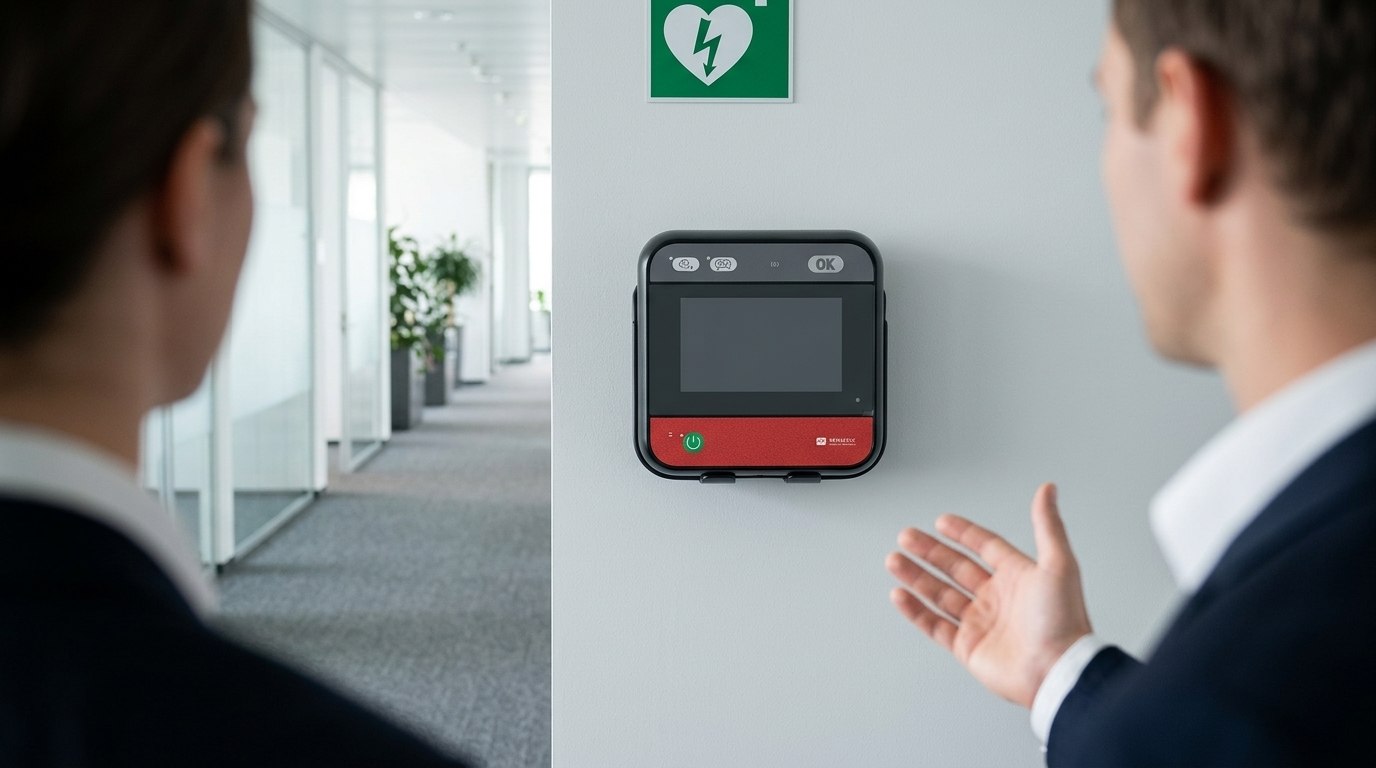
The device runs an automatic self-check every day, covering its electronics, battery and pads, and reports the result to us remotely. We track pad and battery dates and deal with anything that needs attention. There is no dashboard for you to check: we do the watching, and you hear from us when something matters.
How is this different from just buying a defibrillator?
A bought device is only as ready as the last time somebody checked it. Pads expire, batteries fade and the person who owned the job moves on. With Complete Protection or rental, the device, the monitoring, replacement pads and the support come as one arrangement, so readiness never depends on one person remembering.
Do our staff need medical training to use it?
No. The myPAD talks the user through every step by voice and screen, analyses the heart rhythm itself and, being fully automatic, delivers a shock only when one is genuinely needed. Training builds confidence and we help you develop staff briefings, but the device is designed for an untrained first responder.
Is it safe to use on children?
Yes. One press of the child button switches the device to paediatric mode with a lower energy level, with no separate child pads to find. Follow the voice prompts as normal.
Who is the service for?
Any UK workplace. We cover offices, warehouses and industrial sites, construction, hospitality and venues, and organisations with several sites, each with placement logic suited to how the site actually works.
Set-up
From first call to *ready*
What happens between deciding and having a device set up and ready.
How does the assessment work?
Remotely, and free. A short call plus photos or a video walkthrough of your site is usually all we need to advise on placement, using walking-time logic rather than guesswork. Nothing to arrange, no cost, no obligation.
What does set-up involve?
With Complete Protection and rental, we visit to unpack, check and activate the defibrillator, connect it to monitoring, register it, help you choose where it lives and show your team how it works. Set-up does not involve wall fixing or electrical work. If you take a cabinet, we supply it and advise on where it should go; your facilities team or contractor mounts it.
Where will the defibrillator go?
Somewhere visible, unobstructed and quickly reachable from the busiest parts of your site. We plan placement around walking time, weighted towards higher-risk areas, so the device is inside the window that matters wherever the emergency happens.
Can it live outdoors?
Yes. Heated outdoor cabinets protect the device year-round and can make it available beyond your own working hours if you choose. We advise on the right housing for the environment it will face.
Do you register the device?
Yes, with The Circuit, the national defibrillator network, as part of set-up. A registered device can be found by the ambulance service when a caller nearby needs one.
What about signage?
Provided. We supply standard AED signage and advise on positioning, so the device can be found from the main routes by someone who has never had to look for it before.
Monitoring and support
Looked after, *long after set-up*
The part that carries on for years: watching, replacing and resetting.
What does the monitoring actually check?
The result of the device's automatic daily self-check, covering its electronics, battery and pads, plus pad and battery expiry dates. A problem is picked up at the next daily self-check, not at an annual inspection.
What happens if a fault is found?
You hear from us with what happens next. We arrange the fix or the replacement, confirm the device is ready again, and keep you informed from fault to fixed, without your team chasing anything.
What happens after the defibrillator is used?
Tell us, and we will replace the pads, check the device and confirm it is fully ready again as quickly as possible. On Complete Protection and rental, replacement pads after use are included.
Do we need to check anything day to day?
No. A glance at the OK indicator as you walk past is welcome, but there is nothing to log, test or remember. That is the point of the service.
What do replacement pads and batteries cost?
It depends on the option. Complete Protection: replacement pads are included, both before they expire and after the device is used; the device is yours, so a replacement battery is charged when one is needed. Rental: pads, battery and repairs are all included. Outright purchase: no monitoring, and replacements are charged. See pricing.
Can you monitor a defibrillator we already own?
In many cases, yes. Tell us the make and model and we will confirm what is possible.
Do you cover multiple sites?
Yes. Organisations with several sites get one consistent standard at every location, with every device monitored by us and one team to deal with.
Still got questions?
Ask us anything about workplace defibrillators. Plain answers, no pressure.
Contact Work Defib